Contribution limits are monetary restrictions on the amount an individual or group can donate to a political actor – usually a candidate, political party, or political action committee. The Supreme Court first allowed limits on contributions in Buckley v. Valeo. The Court’s ruling acknowledged that contribution limits were a restriction on First Amendment activity, but allowed them on the theory…
Buckley v. Valeo confines campaign finance regulation to actual corruption, rather than amorphous claims about “undue influence.”
Those who blame Buckley for our current problems are wrong to do so. A contrary decision would have made things worse.
The Institute for Free Speech held a virtual panel with Bradley A. Smith, Joel Gora, and Eugene Volokh to reflect on the history of ...
Despite sustained criticism from all sides, Buckley's core principle persists: government cannot ration political speech.
The core First Amendment principles of Buckley v. Valeo endure after fifty years.
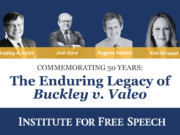
Experts and scholars reflect on Buckley’s legacy on the decision’s fiftieth anniversary
James L. Buckley, et al. v. Francis R. Valeo, Secretary of the United States Senate, et al. argued before the Supreme Court of the United ...
A response to "How billionaires took over American politics"
Today’s Supreme Court oral argument in NRSC v. FEC ably illustrated that limits on coordinated political party expenditures violate the First Amendment
National Republican Senatorial Committee, et al. v. Federal Election Commission, et al. argued before the Supreme Court of the United States on December 9, 2025.